Sunday, March 22, 2020

Office of the Mass: 4th Sunday in Lent

Introit
Rejoice, O Jerusalem: and come together all you that love her: rejoice with joy, you that have been in sorrow: that you may exult, and be filled from the breasts of your consolation. Ps. I rejoiced at the things that were said to me: we shall go into the house of the Lord. Glory be to the Father.


Kyrie
Lord, have mercy.
Lord, have mercy.
Lord, have mercy.
Christ, have mercy.
Christ, have mercy.
Christ, have mercy.
Lord, have mercy.
Lord, have mercy.
Lord, have mercy.


(Gloria Omitted in Lent)

V. O Lord hear my prayer.
R. And let my cry come unto Thee.


Collect
Grant, we beseech Thee, almighty God, that we, who for our evil deeds justly deserve to be punished, by the comfort of Thy grace may mercifully be relieved. Through our Lord. 
 
Epistle
A Lesson from the Epistle of Blessed Paul the Apostle to the Galatians.
Brethren: It is written that Abraham had two sons: the one by a bondwoman and the other by a free woman. But he who was of the bondwoman was born according to the flesh: but he of the free woman was by promise: which things are said by an allegory. For these are the two testaments. The one from Mount Sinai, engendering unto bondage: which is Agar: for Sinai is a mountain in Arabia, which hath affinity to that Jerusalem which now is, and is in bondage with her children. But that Jerusalem which is above is free, which is our mother. For it is written: Rejoice, thou barren that bearest not: break forth and cry, thou that travailest not: for many are the children of the desolate, more than of her that hath a husband. Now we, brethren, as Isaac was, are the children of promise. But as then he that was born according to the flesh persecuted him that was after the spirit: so also it is now. But what saith the scripture? Cast out the bondwoman and her son: for the son of the bondwoman shall not be heir with the son of the free woman. So then, brethren, we are not the children of the bondwoman, but of the free: by the freedom wherewith Christ has made us free.


Gradual
I rejoiced at the things that were said to me: we shall go into the house of the Lord. V. Let peace be in Thy strength: and abundance in Thy towers.
 
Tract
They that trust in the Lord shall be as Mount Sion: he shall not be moved for ever that dwelleth in Jerusalem. V. Mountains are round about it: so the Lord is round about His people, from henceforth now and for ever.

V. O Lord hear my prayer.
R. And let my cry come unto Thee.


Gospel
A Continuation of the Holy Gospel according to St. John
R. Glory to Thee, O Lord.


At that time Jesus went over the sea of Galilee, which is that of Tiberias: and a great multitude followed Him, because they saw the miracles which He did on them that were diseased. Jesus therefore went up into a mountain: and there He sat with His disciples. Now the pasch, the festival day of the Jews, was near at hand. When Jesus therefore had lifted up His eyes, and seen that a very great multitude cometh to Him, He said to Philip: Whence shall we buy bread that these may eat? And this He said to try him: for He Himself knew what He would do. Philip answered Him: Two hundred pennyworth of bread is not sufficient for them, that every one may take a little. One of His disciples, Andrew, the brother of Simon Peter, saith to Him: There is a boy here that hath five barley loaves and two fishes: but what are these among so many? Then Jesus said: Make the men sit down. Now there was much grass in the place. The men therefore sat down, in number about five thousand. And Jesus took the loaves, and when He had given thanks, He distributed to them that were set down: in like manner also of the fishes, as much as they would. And when they were filled, He said to His disciples: Gather up the fragments that remain, lest they be lost. They gathered up therefore, and filled twelve baskets with the fragments of the five barley loaves which remained over and above to them that had eaten. Now those men, when they had seen what a miracle Jesus had done, said: This is of a truth the prophet that is to come into the world. Jesus therefore when He knew that they would come to take Him by force and make Him king, fled again into the mountain, Himself alone.

V. O Lord hear my prayer.
R. And let my cry come unto Thee.


Offertory
Here is made a prostration.
Praise ye the Lord, for He is good: sing ye to His name, for He is sweet: whatsoever He pleased, He hath done in heaven and in earth.


Communion
Jerusalem, which is built as a city, which is compact together: for thither did the tribes go up, the tribes of the Lord, to praise Thy name, O Lord.

V. O Lord hear my prayer.
R. And let my cry come unto Thee.


Postcommunion
Grant us, we beseech Thee, O merciful God, ever to celebrate with sincere worship and receive with faithful hearts Thy holy mysteries, of which we continually partake. Through our Lord Jesus Christ, etc.

V. O Lord hear my prayer.
R. And let my cry come unto Thee.
V. Let us bless the Lord.
R. Thanks be to God.
V. O Lord hear my prayer.
R. And let my cry come unto Thee.


Last Gospel
The beginning of the Holy Gospel according to St. John.
Glory be to Thee, O Lord.

In the beginning was the Word, and the Word was with God, and the Word was God. The same was in the beginning with God. All things were made by Him, and without Him nothing that was made. In Him was life, and the life was the light of men: and the light shineth in darkness, and the darkness did not comprehend it. There was a man sent from God, whose name was John. This man came for a witness to give testimony of the light. That was the true light which enlighteneth every man that cometh into this world. He was in the world, and the world was made by Him, and the world knew Him not. He came unto His own, and His own received Him not. But as many as received Him, to them He gave power to become the sons of God: to them that beleive in His name: who are born, not of blood, nor of the will of the flesh, nor of the will of man, but of God. Here is performed a prostration.
And the Word was made flesh, and dwelt among us, and we saw His glory, the gory as of the only-begotten of the Father, full of grace and truth. Amen.


Antiphon
To Thee belongeth praise, to Thee belongeth hymns, to Thee be glory, God the Father and the Son, with the Holy Ghost, forever and unto ages of ages. Amen.

Let us pray.

O God, the protector of all who hope in Thee, without Whom nothing is strong, nothing is holy, multiply Thy mercy upon us, that with Thee for our ruler and leader, we may so pass through the good things of this life as not to lose those which are eternal. Through our Lord Jesus Christ Thy Son, who livest and reignest with Thee forever and ever, Amen.
[Additional Collect from the Mass in Time of Pestilence:

O God, Who desirest not the death of sinners, but their repentance, look mercifully upon Thy people when they turn to Thee, that, while they show devotion to Thee, Thou mayst turn away from them the scourges of Thine anger. Through
our Lord Jesus Christ Thy Son, who livest and reignest with Thee forever and ever, Amen.]

V. O Lord hear my prayer.
R. And let my cry come unto Thee.
V. Let us bless the Lord.
R. Thanks be to God.
V. And may the souls of the faithful departed, by the mercy of God, rest in peace, Amen.

Thursday, October 10, 2019

The Amazon Synod, and the Liberal Enemies of Inculturation

Despite my being on the front lines research on (ahem) “indigenous liturgies”, I have not been inspired to comment on the Amazon Synod or even, frankly, follow the news of it. That for a very simple reason. When it comes to inculturation, you have to do a massive amount of homework on each community and its history and language to do it right—or even just to comment on it intelligently.

And I really don’t know what the situation is in the Amazon. I have no knowledge of the peoples there or the history of its Catholic missions. But when I saw Fr. Zuhlsdorf mention a putative “Amazonian Rite” of the Mass, I felt compelled to address this idea with some general points and underlying principles that I’ve worked out from my own experience of American and Canadian inculturation.

First, do not let modernists and liberals anywhere near any liturgical books. Ever. Their motives are defective at best and insidious at worst, and by and large they have no idea what the heck they are doing. If given the chance, they will destroy indigenous Catholicism in the process of “saving” it.

I know that’s a strong assertion. But it’s not a strong assertion that I offer just because I’m some cranky, close-to-50 traditionalist with an axe to grind. It’s a strong position that I have, from 20 years of research in this specific area, slowly arrived at by studying how the 1960s liturgical reform was implemented.

I am probably going to upset many people with this next comment, and particularly some Native American Catholics who are emotionally invested n the current status quo. But not everyone is as fortunate as I am to have such intimate contact with the traditional sources. And since I have a duty to the larger Native community to tell the truth, I’m going to say it anyway.

Almost all of the “indigenous liturgies” of the post-Vatican II period are stereotyped, patronizing junk. What we see passed off as “Native American liturgy” in too many places is really just a mangled Modernistic parody of the Roman Rite, spiced up with a few token Indian stereotypes that could have been yoinked from the set of any cheesy 50s western: Plains-style headdresses, peace pipes, and Pendleton blankets.

I have nothing against any of those objects in their proper cultural context. But they shouldn’t be displayed as mere props to satiate the primivitist fetish that pretentious European liberals have toward my Native countrymen. They are authentic elements, yes, but garbled into an ignorant progressive’s opinion of what an “indigenous liturgy” should look like, rather than what an indigenous liturgy actually does look like.

For centuries, the Algonquian and Iroquoian tribes along the St. Lawrence had their own distinct uses of the Roman Rite: half-Latin, half-Native liturgies first shaped by missionary adaptation in the colonial period and then carefully preserved, transmitted, and even expanded until Vatican II. In some Native languages, these now-obsolete liturgies were called the “Native Masses” or “Indian Masses”.

It was the traditional Latin Mass that the Indians called that, mind you—not the Novus Ordo. And that should tell you which liturgy was actually best adapted to the sensus fidelium in these communities. But to the Modernists, these traditional Masses were apparently just outmoded “Tridentine” relics that stood in the way of their liturgical Utopia, like the old buildings of Rome must have seemed to the deranged emperor who dreamed of a glorious Neropolis.

As Christopher Vecsey points out in his books on Native Catholicism, when these Latin/Native liturgies were replaced with the English Novus Ordo Missae, many American Indian Catholics felt that they were being robbed of their culture. And, in fact, they were.

So while inculturation marched on after 1970, it had lost much of its ancestral connection to what went before, and everyone after that day who waxed rhapsodic about respecting indigenous tradition would have a glaring inconsistency at the heart of their argument—whether they knew it or not.

By and large, liberal-minded Catholics who proudly defended Native tradition did not bother to bury their noses in the Tsiatak Nihononwe to study Mohawk or Algonquin adaptations of the Terribilis and the Gaudeamus Introits and their use through the festal and penitential liturgical seasons. They didn’t squint through archaic Abenaki manuscripts in one hand, with Rale’s dictionary in the other. They didn’t ferret out and perform concerts of Native-language plainchant and polyphony. They didn’t promote or revive devotional wampum.

Instead they issued reports, as the USCCB did in Native American Catholics at the Millennium (2002), that continued to promote a garden-variety, Eurocentric Novus Ordo lightly flavored with generic eagle feathers, drums and tobacco.

This is the “indigenous liturgy” situation as it unfolded in North America, and this is why I am supremely wary of any priest, bishop, or even Pope who favors the liberal approach to inculturation. Liberals had 50 years to do a good job of inculturation, and they failed. If they were truly serious about the issue back in the 1960s, they would have worked to spread the centuries-old Indian Masses that were already in place—not completely gut them and start over.

Brazil may, for all I know, be a completely different story—but the voices in favor of an “Amazonian Rite” seem to be the same ideologically as the vandals who sacked the Canadian missions.

Let me make one thing clear. It is impossible—impossible—to create a new Rite. The Apostles and the Church Fathers who formulated the existing Rites—the Roman, Mozarabic, Ambrosian, Byzantine, Syriac, Coptic—are not around anymore, and there is no one left on earth with the authority to do the job. Oh sure, we have had scholars like Annibale Bugnini who gleefully assumed the task—but if you force your unwilling brain to stitch together the phrase “the Divine Liturgy of Annibale Bugnini”, you realize the inherent ridiculousness of what he did.

But that’s an exaggeration, you might reply...it was done under the authority and permission of Pope Paul VI. That is a much less offensive author, I admit, and not an improper one, even though there are strange stories how little he actually knew about it. But still, exactly what right does any modern Roman Pontiff have to completely gut and reorganize the Roman liturgy as if it was his personal property to dispose of, rather than a trusted possession he was tasked with preserving and protecting?

I can hear the objections now. Well there’s no solid evidence that the Apostles and Church Fathers wrote the liturgies ascribed to them. Ok let’s suppose that to be true. But the fact that people still called them by Apostolic and Patristic names indicates that the Catholic faithful naturally want their rituals authored by unquestionably holy saints, and sanctioned by immemorial tradition. If there is any doubt that Chrysostom or Basil authored the Byzantine liturgy, there is still no doubt that people down the centuries felt like these men should have been its authors. Why is that? Well, it’s obvious—because Sts. Chrysostom and Basil could be trusted to do the job right. If the highest and holiest prayer on earth can be written or extensively revised by anyone, we want the job done by the holiest and highest authorities.

I do not know who would be in charge of writing a putative Amazonian liturgy. It is possible that he would be a top-notch Amazonian scholar. But unless he is a holy man as well—someone of unimpeachable orthodoxy on the top rungs of the Ladder of Divine Ascent—I don’t give one fig for his scholarship. Scholars can be horribly wrong, and if they are not also saints you can never quite be sure of which side of the angelic hosts they are really serving when they are deciding on revisions.  Saints might not always make their arguments as scholarly as we would like, they might not proceed on a ruthlessly logical basis, but since their whole ethos is oriented toward God you won’t ever be led astray by following their lead. As the Archbishop of Philadelphia has sagely observed—“the only true authentic inculturators are not theologians, or bishops, but the saints.” You know him—the Potawatomi bishop who has been pointedly denied the title of Cardinal. The wrong sort of indigenous person......apparently.

Anyone who does this job of liturgical inculturation has to understand their solemn responsibility not only to the community they are working for, but also the tradition they are purporting to work within. Ideally, such a person would review every stitch of historical evidence he could find on mission liturgies in the Amazon. Only when he has a firm grasp of the historical situation, can he then move accordingly. There are so many variables to consider—were there any previous Catholic missions? Do they have existing unique liturgical expressions? Do we have manuscript or printed evidence? Is this pagan practice theological or merely cultural? What precedents did the early missionaries set?

When Eugene Vetromile, missionary to the Abenaki, was asked by his bishop to change the traditional Abenaki baptismal formula, Vetromile declined “for the respect of that old formula”, that he had found “preserved among the Indians—made by their first missionaries, sanctioned by their successors, and which we do not feel prepared to alter.” We hardly hear such a natural reticence to mess with existing tradition anymore, so fixated have we become on novelty and alleged improvement—but it is as sound an instinct as the old Hippocratic oath: “first do no harm.”

I have admittedly gone into my research with a pre-conceived hypothesis on what an “Indian” Mass or an African-American Mass would look like. But I have been in both cases forced to re-orient my thinking, sometimes dramatically, by the primary source material I found.  Each cultural group within the church has its own heritage, its own patrimony to draw from. And the responsible scholar will adapt to what he discovers without trying to push it in a direction it never wanted to go. For example, the Catholic Indians of Quebec had a unique Mass but no unique liturgical calendar. The Black Catholics of the United States had no unique Mass that I can find, but they did observe a unique liturgical calendar. It’s the actual customs of the community that matter—not whatever novelties we can dream up.

Let me offer, though, a small concession. I would have no theoretical problem if the Amazon would organically develop a new Use of the Roman Rite. Uses are just local variations of Rites. We’ve always had plenty of those around, and they are of comparatively late derivation. The Algonquian/Iroquoian ones appear around A.D. 1700. The Divine Worship Missal of the Ordinariates is an even more recent synthesis. And sometimes they don’t quite work out—like the neoGallican uses in France. With these we can afford to be slightly more adventurous and perhaps even experimental.

A new Rite, though, with a dramatically modified text and, perhaps, a whole new anaphora is a patently ridiculous and arrogant proposition. It was ridiculous and arrogant in 1970 and it still is in 2019, despite all the protestations to the contrary. It is an act of supreme hubris for any Catholic liturgist to falsely claim for themselves the gravitas of a Gregory, an Isidore, an Ambrose. It is an honor they have not earned.

The call for an Amazonian Rite at this point in history, I think we all sense, is nothing more than a liberal Catholic power play that does not, ultimately, have the good of the Amazonian Church in mind. Just hide your heresies behind a select group of easily manipulatable patsies (in the 60s it was gullible university students—now it’s poor Amazonians), and then use whatever permissions you gain to then run over the faithful Catholics in the pews with a liturgical bulldozer.

Liberal Catholics have done incalculable damage to true inculturation by infecting it with their Modernist poison. They were never the champions of indigenous people that they claimed to be—and now they have become incorrigible European imperialists with a pseudomonotheistic zeal to install giant idols of their false deity—that indolent Prussian atheist—in every culture on earth.

I leave with some parting advice for intelligent devout Catholics debating the goings-on in the Synod.

If you are not knowledgeable about Amazonian history and culture, it is not going to be productive attacking the idiocies of the synod on a specific cultural basis.  I have heard a few arguments bandied about that are, well, silly—like the whole business about the feathered hats. I’m not sure how we attack “pagan clothing” when the priestly vestments of the Roman Rite are directly descended from garments worn in antiquity. And it will also be surprising news to 200 years of devout Iroquois Christians that the gustoweh is suddenly an affront to Almighty God.

Keep the argument on the larger theoretical level—not about the Amazon specifically, nor even about paganism, but more about the way that liberal Catholics are disingenuously using the Amazonians as a cover to smuggle in their own asinine theology. Europeans are your main enemies here—not Natives. Accuse them pointedly and directly of hegemony, cultural imperialism, and of exploitation of Native people to serve the political left. Find, cite, interview, and hand over your media megaphones to contrary indigenous voices such as Jonas MacuxĂ­, recently interviewed by LifeSite News.

To defeat the smarmy liberal elite on this, we need to explode their entire raison d’etre—that their only goal is to welcome and help Native communities live in the Church. Show the world how what they are doing is accomplishing the exact opposite, and they, being rather cowardly and frankly addicted to worldly praise, will run away in bewilderment that anyone dared question their motives.

As for me, well, I’m not going to give this Synod much more attention; I have an Algonquin Introit to work through.

Friday, December 7, 2018

Corona of the Immaculate Conception

As we approach the patronal feast day of the United States, it's the perfect time to mention a beautiful devotion to Our Lady of the Immaculate Conception.

The Corona of the Immaculate Conception is a chaplet composed by a Jesuit priest who was one of North America's great explorers: Father Jacques Marquette.


Unfortunately, the Corona is not very well known. There's another, better known devotion called the "Chaplet of the Immaculate Conception" written by St. John Berchmanns. But in terms of authorship and historical context, Marquette's Corona has a special significance for Americans and Canadians.

Let's set the stage with an account of the Corona from Marquette's Jesuit superior Fr. Claude Dablon, writing from Montreal in 1677:
"Some months before his death, he [Marquette] said every day with his two men a little Corona of the Immaculate Conception which he had devised as follows: After the Credo, there is said once the Pater and Ave, and then 4 times these words: Ave filia Dei patris, ave mater filii Dei, ave sponsa Spiritus Sancti, ave templum totius Trinitatis: per sanctam virginitatem et immaculatam conceptionem tuam, purissima Virgo, emunda cor et carnem meam: in nomine Patris, et Filii, et Spiritus Sancti, — concluding with the Gloria Patri, the whole repeated three times."
For a long time I never found an actual Corona of the Immaculate Conception for sale anywhere. So I went ahead and made my own with cord/twine, 15 blue oval beads, and a miraculous medal.

The Rosary Workshop now offers a fancier version of the Corona. You can also use St. John Berchman's Chaplet of the Immaculate Conception, which has the same arrangement of beads.

How to Say the Corona of the Immaculate Conception


1. On the medal, say the Apostles' Creed.
2. On the first bead, say 1 Our Father and 1 Hail Mary.
3. On each of the next 4 beads, say a Corona Prayer:
Hail Daughter of God the Father,
Hail Mother of God the Son
Hail Spouse of the Holy Spirit,
Hail Temple of the entire Trinity.
By thy holy virginity and Immaculate Conception,
O Virgin most pure,
cleanse my heart and my flesh.
In the name of the Father,
and of the Son, and of the Holy Spirit.
4. End with 1 Glory Be.
5. Repeat steps 2-4 two times.

If you'd prefer to say the chaplet in Latin, the text of the Corona prayer can be found italicized in the passage from Fr. Dablon above.

Thursday, November 29, 2018

Advent Hymns and Carols

Amanda at The Homely Hours has a list of Advent hymns and carols for each day of the season. It's a great compilation, and a timely reminder for us to keep the spirit of the season.

There is so much beloved Advent music. I doubt many who know it would be eager to toss it aside--even for a few extra weeks of Christmas carols.


Thursday, August 30, 2018

The Roof Collapse atop St. Peter's Church

So the roof collapsed on a Church in Rome today. No one was hurt, thank God.

This was the Church built atop the Mamertine Prison where St. Peter was imprisoned in Rome: known as San Giuseppe dei Falegnami or San Pietro in Carcere. The titular cardinal of San Giuseppe is Francesco Coccopalmerio. Remember him?

A Church's roof just fell in. This week. Where the first Pope was chained, imprisoned, and then miraculously freed. The Church under the titular leadership of Francesco Coccopalmerio.

Fun fact: a related cathedral in Rome is St. Peter in Chains. There is a legend that Pope Leo I compared the chains of this church to those of Mamertine Prison, and they miraculously fused together. The current Cardinal titular of this Church? Donald Wuerl.

All just coincidences, I'm sure. Just like the lightning striking the Vatican.

Thursday, October 26, 2017

Hallowtide: The Window to Heaven and Hell

Halloween is an eminently Catholic holiday, but the average American would be forgiven for never realizing it.

Perhaps even we in the Church have not realized how this holds true even for the worst aspects of the modern bastardized holiday—the gluttony, the immodesty, the perverted iconography, and the adoration of death and the demonic. All of these are, in an odd way, as much a part of this liturgical season as the Saints.

Admittedly, the propers of Hallowtide are mostly concerned with the crowns of beatitude rather than the powers of hell. The latter make an appearance—but only in a few select places, and never for very long.

The Communion verse for the All Hallows Eve Mass has a glancing reference:

Justorum animae in manu Dei sunt, et non tanget illos tormentum malitiae—"The souls of the just are in the hand of God, and the torment of malice shall not touch them"
And the Office of Matins for All Souls' Day has the following excerpt from Venerable Bede on the life of the blessed:

There the devil will be no more an object of fear; there no evil spirits lie in wait; there, the dread of hell will be gone.
So the Church has not forgotten that there are evil spirits to be saved from. She remembers. She just does not dwell on the powers of hell during this season. We might well ask—why not, when everyone else is?

Because in Hallowtide, the Church is standing in contrast to the world.

She calls attention to what she represents, while the world calls attention to what it represents. She is the light, and it is the darkness. She stands with the angelic hosts, and it stands with the demonic legions. She boasts in the modesty of saints, and it boasts of the profligacy of the damned.

The world's freakish and ghoulish Halloween nightmares furnish us with a crucially important icon for meditation—they put on flagrant display the other half of the lesson that the Roman liturgy is tastefully circumspect about. At the end of October, Almighty God has allowed our enemy, perhaps even forced him unwillingly, to drop his mask and display his ultimate reality for everyone to see.

This world is the princedom of the devil. It is the antechamber to hell. If we ever doubt that, and tend toward daydreaming only of idyllic Arcadian glens and fairies dancing in sun-dappled forests, it will only take a 9-11 or an ISIS to wake us. In a puddle of our own blood.

All around us, right now, men and women are selling their souls to pride, to money, to power, to sex, to hatred, to any or all of the seven deadly sins. Some of them will be saved from that fate by the grace of God. But many...many...will not.

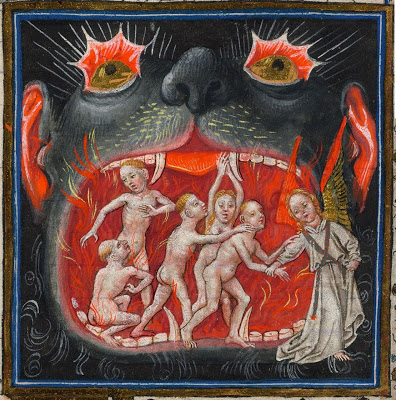
The Middle Ages had a keen sense of horror. Their art proves it. They showed a readiness to use ghoulish images and devices to make a theological point. They made the gate of hell a mouth—which frankly gets far closer to the devouring, insatiable nature of the demonic than an inanimate, static cave which a person can walk in and out of at will.

Yet the medievals were no nihilists. They saw both the transcendent splendor of love and the monstrous corruption of evil. Theirs was not a pastel, soft-focus Christianity but one in bold colors: bright golds, bloody crimsons, and pitch blacks.

We modern Catholics have lost much of their wisdom. We have rashly judged their world too primitive, too coarse, too folklorish to be credible in an age of science. But having lost the sense of the monstrous, the hideous, the hellish, having psychologized and explained away evil to a mere mistaken tendency or uninformed worldview, we have lost the truth of the world. We are in desperate need to behold evil once more as it truly is. As something unspeakably terrible and ugly.

And this is precisely where the world comes in, filling a liturgical mission it didn't even know it had.

During this sacred Triduum, the minions of hell will be crawling from the bowels of the earth to mark their own.

Decadent revelers will blacken their eye sockets, tear their skimpy clothes, and paint festering wounds on their flesh. Devotees of Santa Muerte will offer prayers at the blasphemous altars of Hades and invoke, supplicate, and adore the Negation of Life. Impenitent heretics—no accident the anniversary of their rebellion falls in this period—will exult in their brazen defiance of Christ's Church and train themselves to resist it to the end. Even respectable suburban homeowners will decorate their yards with horrors from Dante's Inferno. Not to warn or teach about the Last Things but purely for "fun"—apparently.

And Catholics? We see the harvest come in, the leaves fall, the nights grow long, and the world turn dark. And through it all we keep our eyes firmly fixed on heaven. We stand with our fellow sinners in repentant tears at the Calvary of the Mass. We invoke the saints for their aid and strive to dress ourselves in their clothes and virtues. We sacrifice and pray for the souls of our dearly departed, putting their needs above our own. And through it all we grow, little by little, in charity toward God and man.

The stark contrast between the Church and the world ought never, and least of all in this time of year, to be confused or muddled. There will be a time for the Church to speak forcefully about hell and the damned, but it is not during Hallowtide. This season is about two paths, and these paths must be laid out clearly and crisply, blazed everywhere along the way with reliable, unmistakable markers of their destinations. So that, in the end, not a single soul can pretend to be surprised at where they have arrived.

God has given us Hallowtide as a three-day window to the Last Judgment in all its bright glory and dark horror. It is an audition for our part in Eternity, a dress rehearsal for that Day of Wrath that lies before us all. The liturgy of the Church versus the revelry of the world.

All of us, whether we are inconstant friends of Christ, avowed enemies of God, or secular revelers seeking nothing more than a bit of amusement—all of us in these three days will be dressing up both literally and metaphorically. And we will all be preparing and training.

Just with very different vestments, and for very different ends.

Saturday, September 23, 2017

Overloading Advent

Don't get me wrong, I'm grateful that Advent is even acknowledged at all in the commercial world. In the United States where we seem to have a preponderance of low-church Christians, the liturgical year is never as well emphasized as it could be.

The difficulty is that Advent is a time of penance and expected waiting, not celebration. Our kids have an Advent calendar courtesy of generous grandparents, but it's all simple things like crackers and candies, and they also got Bible verses to go along with every day, lest we forget what it is we're waiting for.

Companies haven't generally been quite that restrained. Advent has become big business. Pottery Barn has gotten into the fray, and now even Aldi has a wine calendar that is making the rounds.

Nunc est bibendum! Traditionally, the feast of St. John on December 27 was the big day for wine, but once again there seems to be an increasingly sloppy blurring of the two seasons.

Commercial outfits are motivated by and interested in one thing: moving product. There's nothing wrong with that.... our publishing company has a wonderful Advent book for this time of year:

Lynne's book is, though, more oriented toward making simple little crafts with prayers and devotions rather than moving stuff off of shelves. It's not wrong to encourage good solid Advent products like these, just to make gifts and treats the sole focus of Advent instead of tangible helps on the way to discovering what Advent really is.

Advent has a real danger of becoming overloaded with gifts, especially if we add in treats for St. Nicholas's feast, the ever-more popular "let's just exchange Christmas gifts now because we won't be seeing each other during the holidays", and even Hanukkah presents from our Jewish family and friends. Some of this can't be helped. But it seems like if we're not getting gifts, we're thinking about gifts, running around purchasing gifts, worrying about gifts, wrapping gifts.

No one described this pre=Christmas tension with better wit than the great C. S. Lewis, in "Xmas and Christmas: A Lost Chapter from Herodotus."

Let's make sure we Niatirbians-in-spirit maintain a bit of restraint in this penitential season so we can show up with bright shining faces to Mass on December 25th.

Wednesday, August 23, 2017

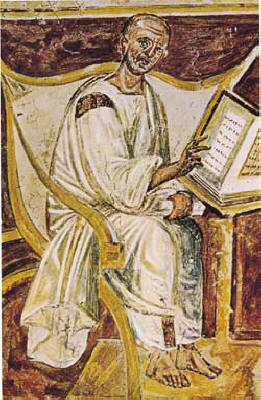
Devotions for the Feast of St. Augustine

Since we will be celebrating the Feast of St. Augustine in a few days on August 28th, I'll be featuring a few lesser-known devotions to this great saint. This inaugural prayer is taken from a prayer-book published by an Irish Augustinian in 1885 and is recommended there for after Confession.

PRAYER OF SAINT AUGUSTINE

BEFORE thine eyes, O Lord, we bring our offences, and confess that the evil we have committed far outweighs what we suffer. We feel the punishment of sin, and yet we turn not from our wilfulness in sinning. If Thou waitest for our amendment, we are not corrected. If Thou chastiseth us, we are not patient. We confess our fault during our affliction, and forget our tears when the visitation is past. If Thou stretchest out thine arm, we proffer obedience; and if Thou suspendest the stroke, we forget our promise. If Thou punishest, we cry for mercy; and if Thou sparest, we provoke Thee again to strike. Behold, O Lord, we confess our guilt. Thy hand is not shortened that it cannot save. Neither is thine ear dull that it cannot hear. Thou hast shown us the manner we may come before Thee, requiring us to act justly, to love mercy, to walk humbly before Thee, and trust, finally, in the merits of our Lord Jesus Christ, who died for our sins and rose again for our justification.

Remember not, O Lord, our offences, nor those of our parents, and take not vengeance on our sins.

Saturday, August 19, 2017

Candace: A Christian Name from Nubia

Nubia was an extremely old civilization, with close cultural ties to Egypt that go all the way back to the dawn of Egyptian history. It even developed its own distinct adaptation of Egyptian hieroglyphics called Meroitic.

One of Nubia’s most visible contributions to Western Christianity is the name Candace. We get it from the New Testament Greek form Κανδακη and the Candacis of the Latin Vulgate, as it appears in the story of St. Philip baptizing the Ethiopian eunuch in Acts of the Apostles:

"And behold, an Ethiopian, a eunuch, a minister of queen Candace of Ethiopia, who was in charge of all her treasures, had come to Jerusalem to worship" -Acts 8:27
Candace ultimately comes from ktke, the word for "queen" or perhaps "queen mother" in the language of ancient Nubia. In the Meroitic script, it is rendered as follows:
The alphabetic hieroglyphs above are read from right to left. They are enclosed in an oval cartouche, indicating that they are part of a royal name; the three dots to the right are a word separator, and then the four symbols, reading towards the left, spell out k-t-k-e. The Greek transliteration is shown below.

This research will be featured in my forthcoming book "The Church for Our People: Studies in Afro-American Inculturation".

The Kisses that Killed Prejudice

On a cold January morning, in the year of Our Lord 1892, the Reverend Dr. Henry L. Phillips entered a Catholic Church and stayed to observe High Mass. He was not himself Catholic. In fact, he was rector of the Crucifixion Protestant Episcopal Church of Philadelphia. But he was a black minister serving a black congregation, and he was there for a special event: the Third Colored Catholic Congress, whose purpose was to gather black Catholic leaders across the United States. Its opening Mass was celebrated by the first recognized black priest in the nation: Father Augustus Tolton. And assisting Father Tolton that day were two white priests: Father John Burke as deacon, and Father John Griffin as subdeacon.

Two days later, Reverend Phillips had occasion to address the delegates to the congress. He said that during the Mass on Tuesday, he had been watching with the closest interest these two white priests at Father Tolton’s side. And what he saw there made a great impression on him. In no other denomination, he said, could such a thing be seen, or would it be permitted.

Because extensive changes to the Mass have taken place since that time, it is easy, perhaps, to miss the full significance of what Reverend Phillips saw that Tuesday morning in Philadelphia. We might simply assume that his remarks merely involve a black priest serving at the altar with white ones. Of course, this would indeed have been a remarkable image in an environment of widespread racial prejudice. But yet that alone doesn’t seem to entirely justify Phillips’ rather striking remarks. Would black and white ministers together really be unseen or unpermitted in any other denomination? Why would a few white priests sitting in on Father Tolton’s Mass be such cause for amazement?

Well, it’s not recorded what exactly Phillips saw that struck him at that Mass. But we can make an educated guess simply by placing the ceremony in its proper liturgical context.

Now if you have been to any traditional Latin High Mass, you’ve probably seen that it includes a number of kisses. These are known as the solita oscula. When the deacon and subdeacon hand an object to the priest or receive one from him, they kiss both the object and the hand of the celebrant. Also, the subdeacon kneels before the celebrant and kisses his hand after reading the Epistle. Then the deacon does the same thing before reading the Gospel. To anyone carefully watching the activity at the altar, these kisses are quite prominent, as are the many other places where the deacon and subdeacon act as humble servants to the celebrating priest.

But imagine these rubrics carried out at Tolton’s Mass on that winter morning in 1892. Two white priests publicly serving, kneeling before, and especially, and repeatedly, kissing the hands of a black priest.

That sight alone could well have been positively shocking in a country that was going through what some historians regard as the low point of American race relations. In that same year of 1892, the number of lynchings would reach a horrible peak of 230, never to be exceeded since. The supposedly “gay” nineties would see new state constitutions disenfranchising voters throughout the South, as well as the northern-dominated Supreme Court enshrining “separate but equal” in Plessy vs. Ferguson.

In his address to the Third Colored Catholic Congress, Dr. Phillips would go on to say that it was true, he knew, that at the altars of the Catholic Church there was no distinction as to color, and that Church has a lever possessed by none other to secure for the colored people the same rights in the workshops as it freely grants them in its sanctuaries. If it exerts its powerful influence to this end, he said, it will be scared by the rush of colored people to its fold and, as for himself, he would bid his three boys Godspeed if they desired to enter the ranks of that or any other Church which would secure for them their just rights.

As American Catholics we have not, sadly, always made use of that lever as well as we should, and our failings in that regard have undoubtedly been the reason that the rush of black Americans into the Catholic Church never quite materialized the way that Daniel Rudd and the other delegates had hoped. Liturgically, also, we seem to have lost all patience for these little gestures of service that undoubtedly so moved Reverend Phillips.

But it is worth remembering that in one of our country’s most shameful hours, an observant clergyman saw how justice and equality could flow out in torrents, if we could only learn to lower ourselves before the altar of God, to see Christ in every human being, and to kill every last prejudice with a kiss.

Wednesday, August 16, 2017

The North African Liturgical Calendar: a Church Reborn

The African Church once boasted 400 bishops, but after the Islamic invasion it was slowly starved of support until its distinct traditions were for the most part lost to Christendom.

But in 1632, Catholic missions were founded in Algeria, and two hundred years later, France's invasion of the country and eventual conquest allowed the Church greater liberty to operate. Algiers was named a diocese in 1838.

The idea of reviving the ancient African patrimony can already be seen in the work of the first two bishops of Algiers: Antoine-Adolphe Dupuch and his successor Louis-Antoine-Augustine Pavy. They produced for the new diocese a liturgical calendar that drew heavily from the African saints mentioned in the Roman Martyrology, though until then seldom actually commemorated at Mass:

October features a number of these distinctly African saints, including Felix and Cyprian; Agileus; Martinian, Saturnian and Maxima; Rogatian and Felicissimus; Quodvultdeus; Gaudiosus; and Deogratias.

The great Charles-Martial-Allemand Lavigerie became the third bishop of Algiers in 1867, and in 1884 he realized a lifelong dream of restoring the ancient See of Carthage. Continuing the work of his predecessors, he directed the development of a new Office that gave greater place to African saints, which was approved by Rome in 1883.

To this day, the liturgical calendar of North Africa bears the legacy of this restoration, though many of the dates have now been brought into line with the only ancient African liturgical document that survives: the Calendar of the Church of Carthage.

We sometimes come across the idea that these kinds of restoration projects outside of living memory are improper. That once a longstanding liturgical rite is dead, it ought to stay dead.

To be sure, at this point we've had our fill of archaeologism and the spectacularly bad manner in which supposed "ancient rituals" were yanked still warm from scholarly discussion and forcefully imposed on the entirety of Christendom with shockingly little humility. Never mind whether, like the canon of Hippolytus that went into Eucharistic Prayer #2, there were serious questions about accuracy and application, and let's not even get into the ways in which such restorations were merely a pretext for advancing the cause of modernism.

But however badly such revivals were carried out in the creation of the Novus Ordo Missae, I keep coming back to Benedict's language in the letter accompanying Summorum Pontificum:

“What earlier generations held as sacred, remains sacred and great for us too, and it cannot be all of a sudden entirely forbidden or even considered harmful. It behooves all of us to preserve the riches which have developed in the Church’s faith and prayer, and to give them their proper place.”
I can't help but thinking that if the Babylonian Captivity of the ancient Roman Mass had endured much longer, and if, as almost happened, it was truly and completely extinguished from the face of the earth for a time, it would nonetheless be our solemn duty to revive it as best we can. The case of North Africa's liturgical calendar shows that even after centuries of obsolescence, restoration can be done, and done well.

What was sacred, is sacred. No generation has any right to rob another of its liturgical patrimony, and we would be fools to simply accede to an illegitimate suppression of external or internal forces.

And it would be well to remember Whom exactly we serve: a God of an empty tomb.

Thursday, August 10, 2017

The Cross That Can't Be Lost

Françoise Gonannhatenha was forced to mount the wooden scaffold upon which the Onondaga Iroquois tortured their enemies.

But quite an unusual enemy she made. She was an Onondaga by birth, and the ones who now stood poised to take her life were friends and relatives, including a sister who had handed her over to the elders for execution.

What did this woman do to merit such mistreatment from her own people?

Françoise had been baptized years before by Father Jacques Fremin on his visit to Onondaga. She had lived as an Iroquois Christian among her people, but persecution made her leave her homeland and join other Christian Iroquois at Sault St. Louis, where she was known for her modesty, piety, and above all charity to the poor.

The devout settlement at the Sault, though mainly Iroquois by blood and language, remained close allies of the French, and so their former countrymen declared them enemies of state.

In 1692, an Iroquois army apprehended Françoise, her husband and two friends in a canoe. They mercilessly killed her husband, and dragged the three women back to Iroquoia, pulling their fingernails out and burning the tips of their bloody fingers in pipe-bowls. The other two women were sent to two other Iroquois villages, and Françoise was remanded back to Onondaga, where she was condemned to death.

Yet she remained undaunted. Mounting the torture platform, she loudly declared to the crowd that she was a Christian, and was happy to die in her own village at the hands of her own nation. In this, she added, she was only following the example of the Lord Himself.

Her piety annoyed her relatives, and one of them tore away the crucifix that had been hanging around her neck. He then took a knife and carved a cross into her breast.

“There you see,” he mocked, “the cross which you esteemed so much and which prevented you from leaving the Sault, when I went to seek you there.”

“I thank you, my brother,” she replied. “I can lose that cross which you have taken away from me, but you have given me one which I will never lose, not even in death.”

Marked with the sign of salvation, Françoise boldly preached from the scaffold:

“As frightful are the torments which you condemned me to, do not believe that my fate is to be pitied. It is yours which requires pity and groans. This fire, which you have lit for my torture, will only burn me for a few hours, but another fire which is never extinguished is prepared for you in Hell. It is however still in your power to avoid it: follow my example, become Christians, live according to the Laws of the Religion as saints, and you will escape from the eternal flames. Moreover, I declare to you that I wish those no ill, who I see are ready to snatch my life. Not only do I pardon them for my death, but I pray the sovereign Master of Life to open their eyes to truth, to touch their hearts, to give them the grace of conversion and to die in the sentiments that now inspire me.”

These exhortations only increased the fury of her torturers. She was taken down, and for three days was dragged around the village, subjected to all manner of cruelties and insults. Then, on the fourth day they returned her to the scaffold to begin the hideous final act of her martyrdom. Tying Françoise to the stake, they burned her entire body with red hot firebrands and gun barrels for many hours. Under all this agony she did not cry out.

At last they scalped her, threw hot cinders upon her bleeding head, and untied her—expecting she would run about in agony the way so many other victims had done.

Instead the pious widow knelt down next to the stake, lifted her eyes, and offered her last breaths as a final sacrifice to God. They rained down upon her a shower of stones, and overwhelmed, this holy Christian Iroquois finally gave up her soul to God.

Salvation on a Stick

In the Year of Our Lord 1838, Fathers François Blanchet and Modeste Demers traveled to Fort Vancouver at the behest of the bishop of Quebec. The mission entrusted to these two priests was simple on its face, but it was also impossibly vast in its scope. They were to spread the message of the Gospel throughout the Pacific Northwest, in a region that stretched from California to Alaska.

The Fathers, clearly, would need help. They managed to get a few literate white men to serve as catechists for settlers, but this approach would not serve with the native tribes of the area. Each tribe had its own language, and though some were closely related, others were so different that they would have to be learned from scratch. There was the Chinook Jargon, which served as a sort of general inter-tribal language of the Northwest Coast, but it was only a simplified pidgin language useful primarily for trading scenarios, not for teaching theology.

Relying on interpreters, then, the missionaries began to observe how their interpreters very naturally used the native love for rhetoric and oratory to give “a new force and new weight” to Catholic doctrine—in languages that white men could only stammer in.

Blanchet and Demers thus determined that those best suited to catechize the Indians were Indians themselves. But how to transform a mere interpreter into a trained catechist, capable not only of understanding but also teaching the vagaries of doctrine? And how best to communicate theological truths to such catechists, when knowledge of their languages was still crude?

The answer came from an old tradition ingrained in native Northwestern culture itself. Catholicism would be achieved the way Indians had from time immemorial recorded the history of their families and tribes: on a totem.

“In looking for a plan,” Blanchet writes, “[I] imagined that by representing on a square stick, the forty centuries before Christ by 40 marks; the 33 years of our Lord by 33 points, followed by a cross: and the 18 centuries and 39 years since by 18 marks and 39 points, would pretty well answer [my] purpose, in giving [me] a chance to show the beginning of the world, the creation, the fall of the angels, of Adam; the promise of a Savior, the time of His birth, and His death upon the cross, as well as the mission of the apostles.”

This miniature Catholic totem pole was called the “Sahale” stick from the name for God in Chinook.

Abandoning theological abstraction for a straightforward historical narrative proved a masterful stroke of evangelization. Like a tribal or familial totem, the Sahale stick was a symbolic retelling of salvation history in visual terms the natives of the Northwest could readily understand.

All that remained was to put it to the test.

Blanchet had one carved for Tslalakum, a visiting chief of the Straits Salish. After a mere eight days of instruction Tsalakum had mastered the concepts engraved on the stick, and brought it back to his native land. As word spread to other tribes, Blanchet made and gave away eight more at Nisqually in 1839.

Hand-carving the four-foot sticks however, quickly proved too laborious for the burgeoning demand, so Blanchet and Demers switched to drawing the Sahale symbols on paper and calling these pictures “Catholic ladders.”

Almost a year after giving the first stick to Tslalakum, Blanchet was finally able to visit his tribal home on Whidbey Island, hoping to follow up on the chief’s visit with some basic catechesis.

Amazingly, he found a tribe already well familiar with the tenets of Christianity. Chief Tslalakum’s eight days of instruction had produced an entire tribe that not only knew the main points of the faith, but had also managed to learn some hymns as well. Tslalakum had given his first Sahale stick to another chief and made a copy for himself. And chiefs like Witskalatche, Netlam and Sehalapan had similar resounding successes in lands where no priest had ever stepped foot.

The Sahale stick, by successfully “baptizing” an ancient native practice of the Northwest Coast, had proved both a wonderfully ingenious way to teach the faith to the Indians, and also to enrich the cultural patrimony of the whole universal Church.

The Kateri Before Saint Kateri

In the Year of Our Lord 1654 an Iroquois army plunged into the Erie homeland, destroying their main villages of Gentaienton and RiguĂ©. Erie survivors fled deep into the woods and disappeared thereafter from the pages of history, as the triumphant Iroquois returned home with spoils and captives. Among these latter was a young Erie woman named Gandeaktena—and it would later be said that the “misfortune of her country proved the blessing of the captive.”

Gandeaktena was adopted into the Oneida nation of the Iroquois, and was present in 1667 when the Jesuit Jacques Bruyas came to preach in their village. Moved intensely by the Gospel message, her husband Tonsahoten, a fellow captive of the Huron tribe and a Christian, encouraged her to follow her inclinations. She began meeting with Bruyas for instruction, helped him learn the Iroquois language and attended chapel regularly.

Her pagan relatives attempted unsuccessfully to dissuade her from Christianity, but they only served to increase Gandeaktena’s desire to leave the Oneida village and settle among the French where she could worship in freedom. So later in 1667 she assembled a little band of seven souls and journeyed to Montreal over the ice. Baptized by Bishop Laval, she took the name Catherine (or Kateri in Iroquois), and then moved with her husband to establish a brand new settlement near Montreal called La Prairie or Caughnawaga.

From these humble beginnings sprang the great Iroquois mission at Caughnawaga which became renowned for its piety and religiousness. “He has gone to La Prairie,” would become the Indians’ catchphrase for conversion.

Catherine Gandeaktena’s virtues played no small part in the reputation of the famous mission she founded. Called by the Indians the “Mother of the Poor”, the “Good Christian” and the “Pillar of the Faith”, her cabin was a haven for the poor and discontented, and she instructed and catechized many who lived in or passed through the village. So great a charity beat in her noble heart that her confessor had to prescribe limits to it—she was accustomed to “give the best of what she had, and in a quantity which was even excessive.” Catherine founded the Confraternity of the Holy Family, a group of very devout converts, who said as many as 20 rosaries per day and were the mainstay of the mission’s Catholic life.

After five years of devoted charity, Catherine convinced her husband to give away the last bit of wampum they owned, offering them first before the Blessed Sacrament:

“My God, four years ago, I gave to you my Body and soul, and the greater portion of my goods. Here is what remains to me; I present it to you with all my heart. What should I now ask of you after having given you my all, unless it be that, from this moment, you take me yourself, to place me near you?”

The very next day Catherine was struck by a headache and fever. She sensed with joy that the Lord had answered her prayer. Loved ones crowded around her bedside as her husband attended her needs, and the ministering priest had her pray for her own recovery. But she quickly added:

“It has been impossible for me to say from the heart what I have just uttered with the lips. Why ask to remain on earth, since God is calling me to heaven?”

Soon after receiving the last sacraments Catherine became delirious. Her husband continually exhorted everyone to say rosaries on her behalf, and after 8 days of their “unceasing prayer” she slipped into a final peaceful coma.

Catherine Gandeakteana died to this world on November 6, 1673. Her husband distributed all her remaining goods to the poor, asking only for prayers for her soul. It was generally believed however, by Black Robe and Indian alike, that her soul had attained the final bliss of heaven.

Only a few years later another Catherine, surnamed Tekakwitha, would seek refuge at Caughnawaga, and her own reputation would eclipse that even of her predecessor. But it was the holy example of Catherine Gandeaktena that prepared the seed-bed for Saint Kateri’s arrival, by founding a flourishing community of Christian Iroquois at Caughnawaga, the very soil in which the “Lily of the Mohawks” would bloom.

Intro to Tales from the Catholic Frontier

Way back in the days of newspapers (remember those?), I had put together a weekly column called "Tales from the Catholic Frontier" and was shopping it around to various Catholic papers.

The idea behind he column was that I would take about 700 words to tell a brief story from American Catholic history--typically ones that weren't well known. I figured I always had my shovel out anywyay digging up some old bit of church lore, so I might as well put what I found to good use.

So I wrote three sample columns and mailed out some packets. But though I got some positive comments on that proto-venture there were no commitments. So the three samples went back to sleep on my old Mac's hard drive, called up once in a while for nostalgia's sake only to be put back into electronic storage again.

Fast forward to today when, in yet another research foray after a shiny new bit of treasure, I found something that piqued my writing instinct. Soon I had yet another contribution to add to the mix, so I decided to wake the ol' guys out of their slumber and publish everything here.

Enjoy!

Monday, May 22, 2017

The Linguistic Lie Behind Singular "They"

Recently I watched a confrontation between a student and University of Toronto Professor Jordan Peterson, who publicly took a stand against non-binary gender pronouns last year. The student kept stridently insisting Dr. Peterson was morally obligated to use the plural pronoun "they", claiming repeatedly and with absolute confidence that it was historically attested in English and went all the way back to Shakespeare.

Beyond the shocking rudeness with which this claim was asserted, it seemed a rather bizarre assertion to make, and I wondered where it came from. After a bit of digging, I was led, very unfortunately, to what seems to be the source of the claim: the American Dialect Society's Word of the Year for 2015.

Here's the problem. The ADS's statement is shot through with an improper and apparently politically motivated conflation of two historically and grammatically distinct usages of singular "they":

1) an old, often contested but stubbornly enduring usage that was always restricted to a particular context--that I will continue to call "singular they" proper
2) a very new misapplication of the pronoun as an alternative to individuals who refuse to identify with either of the two biological sexes, that I will call "non-binary they"

Note well: I am not asserting that the ADS is unaware of the distinction. Their statements show that they are quite aware of it. What I am asserting, rather, is that the ADS and some of its members are deliberately obfuscating that distinction to advance a political agenda.

The statement the ADS released in 2016 mentions the non-binary aspect of singular "they" multiple times, and indeed that new definition is the entire focus of their decision. Some illustrative statements can be seen in the passages below (emphases mine):

• "They was recognized by the society for its emerging use as a pronoun to refer to a known person, often as a conscious choice by a person rejecting the traditional gender binary of he and she."
• "While editors have increasingly moved to accepting singular they when used in a generic fashion, voters in the Word of the Year proceedings singled out its newer usage as an identifier for someone who may identify as “non-binary” in gender terms."
• “In the past year, new expressions of gender identity have generated a deal of discussion, and singular they has become a particularly significant element of that conversation,” Zimmer said.
In a purely descriptive sense, acknowledging the existence of this new usage is certainly well within the purview and mission of the ADS. The issue is not that non-binary "they" was discussed or even voted Word of the Year, but rather that the organization defended and promoted it with misleading statements. For example:

“While many novel gender-neutral pronouns have been proposed, they has the advantage of already being part of the language.”
Has "they" been part of the English language? Yes. Indisputably. But here's the catch: it has never been part of the language in the way that gender activists imply.

Historically, singular "they" occurred when an unspecified individual from a mixed sex group was being referred to, such as: "Each one of you needs to pick up their stuff". An editor who does not want to use a circumlocution has a couple of choices in such sentences: either use singular "their", or use the (binary!) construction "his or her". Although not every editor acknowledges the grammatical correctness of singular "they", practically speaking these are the two common options. In my own work, I have found that the clunkiness of "his or her" has tended to tip the scales in favor of "they", particularly when multiple pronouns are required.

How did a plural pronoun find itself continually intruding in this position, with a singular subject? I have not consulted any research on this, but I suspect that common speech has tended to support it because of the implicit plurality of the subject as one of a group and also because the plurality of genders of the referents. This is just a hypothesis; I may well be wrong. But whatever its origins and theoretical underpinnings, its usage over the centuries is crystal clear. Singular "they" has only ever appeared in a very limited set of cases, which have themselves been strongly contested by grammarians.

Outside these cases, it is dead wrong. There is absolutely no historical justification for grammatically barbaric sentences such as these, culled from an actual news story: "In Britain, 20-year-old Maria Munir made headlines when they came out as non-binary", and "In the US, an Oregon circuit court went much further, ruling in June that Portland resident Jamie Shupe could change their legal gender to non-binary."

Obviously, gender/sexual identification is the underlying driving issue here, so we need to look at the way English has handled this issue in the past. Cases of uncertain or intermediate sexual identity, of course, are nothing new, and have been known and discussed since antiquity.

The practice has generally been in those cases to simply assign a sexually ambiguous person to the closest of two of the three established genders: masculine or feminine. This assignment could draw from widely different observational parameters, from a mere glance to a medical examination. However, in all cases, the judgment was always made on the same assumed basis. A person's biological sex, as nearly as that could be ascertained, determined their grammatical gender.

To illustrate how forcefully this principle held, we can look at a couple of lectures (here and here) given by Dr. Hay Graham in 1835 at the Westminster School of Medicine on individuals of doubtful sex. Watch the pronouns Dr. Graham uses. Of Maria Pateca: "…she became a man. He afterwards married, but remained beardless." Of Germain Marie: "when she was fifteen years old...she suddenly found herself furnished with the parts of generation of a man...Cardinal Lenoncourt, after the necessary examination…ordered him to assume the habits of his sex." And "Jean Pierre was a woman from the waist upwards, and a man from the waist downwards; and in the centre was a woman on the right side and a man on the left; yet, in point of fact, he was neither one nor the other." Marie Derrier's sex was likewise unable to be agreed upon by medical experts: "Hufeland and Mursinna pronounced this individual a girl; Stark and Marteus, on the contrary, considered it a boy."

The two last cases mentioned—Jean Pierre and Marie Derrier—are precisely where we should expect to see the singular "they" of supposedly longstanding English precedent. But of course, we don't. And it's obvious why we don't. Graham could not have said "*Stark and Marteus, on the contrary, considered them a boy" because that construction would have been flagrantly ungrammatical in natural language. And still is.

If Graham gives us any justification for any non-binary pronoun, that would be "it"—and if that one seems jarringly cold and insulting, remember that we use it more commonly than you might realize at first. We are quite used to asking an expectant mother with absolutely no qualms whatsoever: "Do you know yet if it's a boy or a girl?" A co-worker may be complaining about being cut off in traffic, and you might mischievously inquire about the driver, "Was it a man or a woman?"

I have not reviewed the literature for pronoun use, but I have little reason to suspect that Graham's usage is anomalous. He sometimes presents us with a jarring switch between masculine and feminine pronouns following a medical event or diagnosis, and he sometimes gives us a constant pronoun throughout. But beyond the neuter "it", which for obvious reasons is employed for human beings only in quite limited circumstances, there is no gender outside of "he" and "she" to speak of, even in the most difficult cases of sexual identification. Not "they", not anything else.

As long as the sex of a person was known or was clarified from a previously indistinct or incorrect state, the language has always demanded that the corresponding binary gender—masculine or feminine—be applied. To be sure, in common social circles this application involves a practical, on-the-fly judgment that has worked in the favor of the gender activists: English speakers naturally find it insulting, demeaning, and rude to misgender people and call a man "she" or a woman "he". And since we do not, thank goodness, subject everyone we meet to a thorough anatomical and genetic panel, it has always been easiest to simply extend strangers the benefit of the doubt when visible markers tilted one way or the other. But it is foolish in the extreme to confuse that pragmatic application for a general underlying rule. No one's personal opinion, preference, or mindset has ever had anything to do with the assignment of gender in English. Biological sex dictates grammatical gender. Period. That is simply how English works.

So it's quite deceiving for the ADS to defend the current neologism with a statement so misleading as:

"The use of singular they builds on centuries of usage, appearing in the work of writers such as Chaucer, Shakespeare, and Jane Austen."

Note what that sentence does not say. It does not say that singular they was used for centuries in a non-binary sense. It admits that it merely "builds on" centuries of usage. Again, the ADS knows full well that non-binary "they" is a new coinage, explicitly acknowledged not only in the text of the statement but also by linguist and columnist Ben Zimmer, chair of the ADS's new words committee, in an interview with Business Insider:

"It moves beyond the traditional binary of 'he' and 'she'," Zimmer told Business Insider.

"It feels like an opening up of the language, allowing for a greater possibility of what these pronouns can refer to."

So here's my question. If non-binary "they" is indeed a newly invented term, then what exactly is the purpose of mentioning "centuries of usage" in the first place? Are we explaining its appearance, or trying to justify its appearance? Are we describing language as it exists, or are we actively trying to make it something else?

Of course, language is not permanently fixed, and semantic categories can expand. But linguists have typically been preoccupied with watching words naturally expand to new semantic categories. They have not been typically been encouraging them, artificially, into those categories. And that for a good reason. Attempts to coerce linguistic change do not have a very good track record of achieving what they aim at.

University of Illinois Professor of English and linguistics Dennis Baron has compiled an extremely useful list in his "The Words that Failed: a chronology of early nonbinary pronouns".

What is immediately striking about these pronouns is their lack of consistency. There are over a hundred cited: strange invented combinations from academic and lay proposals, and a few obscure dialect variants. They are a thorough mishmash in terms of derivation, construction, and overall form. Baron is absolutely right to call these "words that failed" and contrast them with the comparatively successful singular "they"—and his thought process, linked on the ADS-L listserv in December of 2015, likely influenced the ultimate ADS decision.

But in another article "The politics of He. Literally", Baron strangely argues as follows:

Today, the literal politics of generic he is settled. As the second-wave feminist slogan puts it, “A woman’s place is in the House, and in the Senate.” And in the White House, as well. And the gender politics of the form is settled as well: all the major grammars, dictionaries, and style guides warn against generic he not because it’s bad grammar (which it is), but because it’s sexist (which it also is). The authorities don’t like the coordinate his or her, either: it’s wordy and awkward. The only options left are singular they or an invented pronoun. None of the 120 pronouns coined so far over the past couple of centuries has managed to catch on. And despite the fact that there are a few purists left who still object to it, it looks like singular they will win by default: it’s a centuries-old option for English speakers and writers, and it shows no sign of going away. Many of the style guides accept singular they; the others will just have to get over it if they want to maintain their credibility."

If you'll permit me to roll my eyes at the cheesy triumphalist progressivism that brackets this paragraph, I can address the essentials of his argument. Baron's logic behind preferring an existing pronoun to an invented one like thon is certainly understandable. It is a sound theoretical instinct, and if I were lobbying for a new pronoun I'd make the same case myself. But here we see the same sloppy conflation that underpins the ADS statement: singular "they" is indeed a centuries old option, but absolutely not for the use he is advocating.

And is it really any easier to force a pronoun into grammatically forbidden territory than to invent a whole new one? Baron characterizes the acceptance of "they" as so inevitable it will destroy the credibility of those who oppose it. Which "they" does he mean here? Singular, non-binary, both? We are left to guess—but while I may heartily agree that the prevailing winds are in favor the former and have set my editorial sails accordingly, I am utterly unable to imagine the latter doing anything but floating ignominiously in the doldrums of the Great Linguistic Garbage Patch. After all, Baron's own research shows that a desired expansion of the word "one"—advocated by quotes he collected from 1868, 1884, and 1888—failed just as badly as "thon" and the rest, despite a history of use much more solid than non-binary "they".

In a slide presentation, Baron gives two disadvantages to singular "they": first that it "drives the sticklers nuts", and second that "People aren’t so comfortable using singular they for specific, named, individuals, especially when the referent is in the same syntactic unit as the pronoun".

Aren't so comfortable??? For goodness' sake, that's admitting the entire point right there! People aren't comfortable with it because they know it isn't natural to the grammar they speak. The activists are blithely minimizing the objections of millions of Anglophones and are trying to impose an invented construction onto a public that does not want it or need it. The sticklers in this controversy are the gender activists, who have invented their own phony grammar for completely non-linguistic reasons and think they should be allowed to cram it down everyone else's throats without so much of a whimper of dissent. To object to their linguistic Jacobinism is not some prissy grammatical fetish—it is defending the good sense of the common folk against the insufferably imperious diktats of the Academy.

So here's the bottom line.

I cannot stand here in 2017, in the middle of the veritable graveyard of failed pronouns that Baron has so helpfully uncovered, and place the mantle of inevitability on a completely unnatural coinage invented by radical gender activists and obsequiously ratified by irresponsible academics and publishers. I am only one editor, but I will happily throw my lot in with Dr. Peterson on this. I will never ever acknowledge non-binary "they" as anything other than atrociously ungrammatical English. Period. But more importantly, the English-speaking world at large will never acknowledge it either. This linguistic hijacking is doomed to eventual failure because it is founded on fallacy, and there's not a stitch any activist can do to change that. Punto, e basta.

In the meantime, since it seems fashionably stylish to make demands on academics, I am calling on the American Dialect Society do three things.

First: retract its grossly misleading conflation of singular "they" and non-binary "they", and specify clearly that the latter has no grammatical precedent in the English language and is an entirely new coinage on par with many other failed prescriptivist proposals of the past.

Second: publicly correct the false claims made by gender activists on the historicity of non-binary "they".

Third: clarify more forcefully to parties outside and inside the society that the ADS only offers its Word of the Year in a descriptive sense, and that it is in no way a prescriptive ratification, approval, endorsement, or advocacy of the words in question.

Realistically, though, I am not expecting any of this to happen. Because we all know the climate of American academia is such that the "Social Justice Warriors" (there's a phrase for 2017) would then show up at the ADS's doors and dish out the same bullying treatment that they gave to Dr. Peterson. And given the plainly telegraphed views of some of those involved, I am not hopeful for any result besides continued capitulation to the hubris of the social engineers and their Babelian fantasies of piercing heaven with a tower of invented pronouns.

Saturday, June 28, 2014

Natural Inculturation: The Heartberry

This morning, while reading "Dickon Among the Lenape", a children's story by M.R. Harrington, I learned that the Lenape Indians call the strawberry the "heart berry". Harrington's book is well known for its attention to detail and accuracy about Lenape culture, and this is no exception. One of my Lenape dictionaries has wde for heart and wtehim for strawberry: -im being the Lenape suffix designating a fruit or berry.

Heartberry. What a perfect name, no?

We get our English name from the straw that was traditionally used to keep the berries off the ground while they were ripening. Which makes sense, but is not terribly descriptive of the fruit itself.

But using the Lenape name as a springboard allows to add something of a new element to our ecclesiastical observances throughout the year.

The heartberry ripens in June.

Which also happens to be the month of the Sacred Heart.

I'm not sure if my Old World ancestors who picked Fragaria vesca among the Appennines ever made any connection between these two June events--they didn't have the etymological connection, and the Sacred Heart isn't terribly old of a feast after all.

But for us here in New World it is simply too excellent of a relationship to pass up. What better way to tie our devotional calendar to the natural cycles of the seasons?

Cor Jesu Sacratissimum, miserere nobis!

Monday, June 9, 2014

The End of Evolution

I'm the first to admit I am not a philosopher, but this article in the WSJ seems to me to betray a massive amount of confusion on the part of some defenders of natural selection.

http://online.wsj.com/news/articles/SB10001424052702304311204579505574046805070

In a nutshell, Dr. Keleman is saying that we need to understand natural selection without recourse to "teleology" and "design". Well maybe if that is our goal we should refrain from using the word "selection"--because the minute you say "selection" you are implying a selecting agent and a process which implies a goal and an end. But we'll lay that aside for a moment to attack the larger point.

Dr. Kelemen primarily objects to kids explaining "biological facts in terms of intention and design, such as the idea that giraffes develop long necks because they are trying to reach the high leaves."

Hence the example of the pilosas:

Dr. Kelemen and her colleagues thought that they might be able to get young children to understand the mechanism of natural selection before the alternative intentional-design theory had become too entrenched. They gave 5- to 8-year-olds 10-page picture books that illustrated an example of natural selection. The "pilosas," for example, are fictional mammals who eat insects. Some of them had thick trunks, and some had thin ones. A sudden change in the climate drove the insects into narrow underground tunnels. The thin-trunked pilosas could still eat the insects, but the ones with thick trunks died. So the next generation all had thin trunks.
Whoa. Wait a second though. Does this really argue against teleology and design?

Dr. Keleman seems to be arguing that the trunk width of pilosas was just a random happenstance that a random climate change operated on in a random way. And I often hear people throwing the concept of "randomness" around a little too freely when it comes to evolution.

But let's not forget something. We tend to think of sexual reproduction as a given because we reproduce that way and most organisms that we know of reproduce that way. But it isn't a given at all. There are plenty of organisms who can clone themselves.

Any gardener can tell you there is an inherent advantage of cloning. A clone assures you of getting the exact copy--so if a vine has exceptional grapes, the clone will have exceptional grapes as well. But an exact copy can be a mixed blessing--in that it transmits not only all of the benefits of the original but also the disadvantages of the original. If that exceptional grape vine is very susceptible to attack by disease, for example, then all its clones will be equally susceptible.

If a plant breeder wants to improve on the original vine by, say, keeping the exceptional grape but also reducing its susceptibility to disease, there is only one way to do that. And that is to forget about cloning the thing, and sexually reproduce it. In other words, breed the grape with another grape, and select from the offspring.

This is the essential element that Dr. Keleman is missing: that genetic variability in a population is, in fact, no random result but rather an end that was deliberately sought and achieved. The very fact that there were pilosas with different thicknesses of nose is an adaptive end of meiosis and sexual reproduction. That is exactly what they are there to bring about.

In other words, the genetic lines of the pilosa were designed to have a certain level of variability specifically to mitigate against the kind of environmental changes Dr. Keleman is talking about.

She introduced the fictional scenario of the pilosas' prey going into underground tunnels. That's a plausible scenario. But we can offer completely opposite ones. Suppose it was a spate of frigid winters, such that the appendages of small animals would be extremely susceptible to frostbite. In that case, the thick-nosed pilosas, with their increased nasal mass, would likely fare better than the thin-nosed ones.

The pilosas, like all organisms, are not mind-readers. They are not prognosticators. No creature, rational or not, can direct itself or be directed to an end that is unknown.

So they do what any sensible, rational human being would do when faced with wealth to protect and a set of unknown circumstances to defend it in: diversify.

Genetic diversification is, itself, the purpose, the intention, and the design behind sexual reproduction. Meiosis and sex exist specifically to provide it.

This is why Dr. Keleman's argument falls flat. Arguing against teleology on the basis of environmental randomness is nonsensical. You might as well argue there is no intention or design in a diversified portfolio because of the randomness of the economy. You might as well argue there is no intention or design in a computer program because of the randomness of its variables.

There absolutely is an end. There absolutely is a design. An end and a design that, like the investor and like the computer coder, recognizes the inherent instability of the environment and has built in a way of dealing with it.

It seems to me that the "folk biologists" here--the natural tendency kids and others have to explaining things as the result of design--are actually exactly correct, where Dr. Keleman is the one who needs a philosophical reorientation. The pilosas did have an end in mind. Their end was to live. To reproduce. To survive and pass on offspring to the next generation. That's the teleology.

In that sense, giraffes DO, in fact, develop long necks because they want to reach the leaves--they want to reach the leaves because they want to live.

No no no, the dogmatic biologist may object, reacting against this bit of "Lamarckism." It's completely random, he asserts. But he is wrong. Meiosis and sexual reproduction may seem to us to give random results. But they are no more random than the various asset classes in the portfolio or variables in the program code.

Saturday, January 4, 2014

A Seton Breakfast

"So earnest was every heart that carrot-coffee, salt pork, and buttermilk seemed too good of a living." --Mother Seton, on her community's first days at Emmitsburg, MD.
In honor of St. Elizabeth Ann Seton's feast today, we will be having a special breakfast based on the fare of the sisters’ first winter in the log cabin at Emmitsburg. Their meals often consisted of bread made of coarse rye and such fare as Mother Seton described above.

So here's our modern version of this breakfast, with admittedly a more festive than penitential spirit!

* Bacon (for Salt Pork)
* Rye Toast
* Buttermilk Pancakes
* Carrot Coffee

Carrot Coffee??! Yep! Believe it or not this coffee substitute was often used in early America when the real thing was either scarce or too expensive.

How to make Carrot Coffee

Wash and cut up a carrot into slices about 1/4” thick. Dry the slices in a dehydrator or in a low oven (around 150°) until they become crispy. Then lightly roast them until they brown, after which take them from the oven and let them cool. They can then be ground in a coffee mill and brewed just like regular coffee.

We'll also be praying the Chaplet of Elizabeth Ann Seton.

Have a great feast day everyone!!

P.S. Catholic Cuisine has a recipe for St. Elizabeth Ann Seton Colonial Brown Bread that is worth checking out.

Saturday, October 5, 2013

October Rosary project: Heraldic Rosaries

Have you ever noticed that a rosary naturally takes a shield shape when you hold it by the middle of the first and fifth decades?

This seemingly useless tidbit was going through my mind a while back when I become fascinated with the rich symbolism and art of ecclesiastical heraldry, thanks to Fr. Jessie Somosierra, Jr.'s blog at http://catholiccoatofarms.blogspot.com/

Then the inspiration hit...could we transfer one shield design to the other and have a heraldry-inspired rosary?

Luckily I happened to have a few different color beads on hand, including the right ones for the coat of arms of my childhood archdiocese of Philadelphia:

Compare with the Philadelphian Archdiocesan coat of arms in the pic below. It proved fairly easy to just imagine the rosary in a shield shape and then transfer the colors of the coat of arms to the beads. I used a spare crucifix I had and I like the way it turned out, but I am considering cutting a custom cross shape if I do another. Here are some more ideas:

I never did find a good way to add the elephants!

In case you want to try designing your own heraldic rosaries, here is a full-page template that you can print out and color. I've left the crucifix/medal out so you can draw that in yourself.

And just a quick note: if you are researching the coat of arms for your diocese you may find images where it is combined with the personal arms of the bishop on a single shield. In those cases, the diocesan arms will be always on the left side. Just extrapolate that left half across the whole shield and ignore the right half.