Amanda at The Homely Hours has a list of Advent hymns and carols for each day of the season. It's a great compilation, and a timely reminder for us to keep the spirit of the season.
There is so much beloved Advent music. I doubt many who know it would be eager to toss it aside--even for a few extra weeks of Christmas carols.
Thursday, November 29, 2018

Thursday, August 30, 2018
The Roof Collapse atop St. Peter's Church
So the roof collapsed on a Church in Rome today. No one was hurt, thank God.
This was the Church built atop the Mamertine Prison where St. Peter was imprisoned in Rome: known as San Giuseppe dei Falegnami or San Pietro in Carcere. The titular cardinal of San Giuseppe is Francesco Coccopalmerio. Remember him?
A Church's roof just fell in. This week. Where the first Pope was chained, imprisoned, and then miraculously freed. The Church under the titular leadership of Francesco Coccopalmerio.
Fun fact: a related cathedral in Rome is St. Peter in Chains. There is a legend that Pope Leo I compared the chains of this church to those of Mamertine Prison, and they miraculously fused together. The current Cardinal titular of this Church? Donald Wuerl.
All just coincidences, I'm sure. Just like the lightning striking the Vatican.
Thursday, October 26, 2017
Hallowtide: The Window to Heaven and Hell
Halloween is an eminently Catholic holiday, but the average American would be forgiven for never realizing it. 
Perhaps even we in the Church have not realized how this holds true even for the worst aspects of the modern bastardized holiday—the gluttony, the immodesty, the perverted iconography, and the adoration of death and the demonic. All of these are, in an odd way, as much a part of this liturgical season as the Saints.
Admittedly, the propers of Hallowtide are mostly concerned with the crowns of beatitude rather than the powers of hell. The latter make an appearance—but only in a few select places, and never for very long.
The Communion verse for the All Hallows Eve Mass has a glancing reference:
Justorum animae in manu Dei sunt, et non tanget illos tormentum malitiae—"The souls of the just are in the hand of God, and the torment of malice shall not touch them"And the Office of Matins for All Souls' Day has the following excerpt from Venerable Bede on the life of the blessed:
There the devil will be no more an object of fear; there no evil spirits lie in wait; there, the dread of hell will be gone.So the Church has not forgotten that there are evil spirits to be saved from. She remembers. She just does not dwell on the powers of hell during this season. We might well ask—why not, when everyone else is?
Because in Hallowtide, the Church is standing in contrast to the world.
She calls attention to what she represents, while the world calls attention to what it represents. She is the light, and it is the darkness. She stands with the angelic hosts, and it stands with the demonic legions. She boasts in the modesty of saints, and it boasts of the profligacy of the damned.
The world's freakish and ghoulish Halloween nightmares furnish us with a crucially important icon for meditation—they put on flagrant display the other half of the lesson that the Roman liturgy is tastefully circumspect about. At the end of October, Almighty God has allowed our enemy, perhaps even forced him unwillingly, to drop his mask and display his ultimate reality for everyone to see.
This world is the princedom of the devil. It is the antechamber to hell. If we ever doubt that, and tend toward daydreaming only of idyllic Arcadian glens and fairies dancing in sun-dappled forests, it will only take a 9-11 or an ISIS to wake us. In a puddle of our own blood.
All around us, right now, men and women are selling their souls to pride, to money, to power, to sex, to hatred, to any or all of the seven deadly sins. Some of them will be saved from that fate by the grace of God. But many...many...will not.
The Middle Ages had a keen sense of horror. Their art proves it. They showed a readiness to use ghoulish images and devices to make a theological point. They made the gate of hell a mouth—which frankly gets far closer to the devouring, insatiable nature of the demonic than an inanimate, static cave which a person can walk in and out of at will.
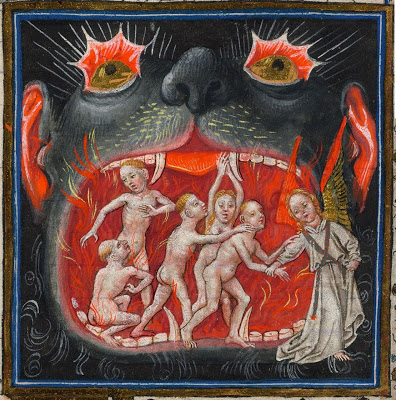
Yet the medievals were no nihilists. They saw both the transcendent splendor of love and the monstrous corruption of evil. Theirs was not a pastel, soft-focus Christianity but one in bold colors: bright golds, bloody crimsons, and pitch blacks.
We modern Catholics have lost much of their wisdom. We have rashly judged their world too primitive, too coarse, too folklorish to be credible in an age of science. But having lost the sense of the monstrous, the hideous, the hellish, having psychologized and explained away evil to a mere mistaken tendency or uninformed worldview, we have lost the truth of the world. We are in desperate need to behold evil once more as it truly is. As something unspeakably terrible and ugly.
And this is precisely where the world comes in, filling a liturgical mission it didn't even know it had.
During this sacred Triduum, the minions of hell will be crawling from the bowels of the earth to mark their own.
Decadent revelers will blacken their eye sockets, tear their skimpy clothes, and paint festering wounds on their flesh. Devotees of Santa Muerte will offer prayers at the blasphemous altars of Hades and invoke, supplicate, and adore the Negation of Life. Impenitent heretics—no accident the anniversary of their rebellion falls in this period—will exult in their brazen defiance of Christ's Church and train themselves to resist it to the end. Even respectable suburban homeowners will decorate their yards with horrors from Dante's Inferno. Not to warn or teach about the Last Things but purely for "fun"—apparently.
And Catholics? We see the harvest come in, the leaves fall, the nights grow long, and the world turn dark. And through it all we keep our eyes firmly fixed on heaven. We stand with our fellow sinners in repentant tears at the Calvary of the Mass. We invoke the saints for their aid and strive to dress ourselves in their clothes and virtues. We sacrifice and pray for the souls of our dearly departed, putting their needs above our own. And through it all we grow, little by little, in charity toward God and man.
The stark contrast between the Church and the world ought never, and least of all in this time of year, to be confused or muddled. There will be a time for the Church to speak forcefully about hell and the damned, but it is not during Hallowtide. This season is about two paths, and these paths must be laid out clearly and crisply, blazed everywhere along the way with reliable, unmistakable markers of their destinations. So that, in the end, not a single soul can pretend to be surprised at where they have arrived.
God has given us Hallowtide as a three-day window to the Last Judgment in all its bright glory and dark horror. It is an audition for our part in Eternity, a dress rehearsal for that Day of Wrath that lies before us all. The liturgy of the Church versus the revelry of the world.
All of us, whether we are inconstant friends of Christ, avowed enemies of God, or secular revelers seeking nothing more than a bit of amusement—all of us in these three days will be dressing up both literally and metaphorically. And we will all be preparing and training.
Just with very different vestments, and for very different ends.
Saturday, September 23, 2017
Overloading Advent
Don't get me wrong, I'm grateful that Advent is even acknowledged at all in the commercial world. In the United States where we seem to have a preponderance of low-church Christians, the liturgical year is never as well emphasized as it could be. Lynne's book is, though, more oriented toward making simple little crafts with prayers and devotions rather than moving stuff off of shelves. It's not wrong to encourage good solid Advent products like these, just to make gifts and treats the sole focus of Advent instead of tangible helps on the way to discovering what Advent really is.
The difficulty is that Advent is a time of penance and expected waiting, not celebration. Our kids have an Advent calendar courtesy of generous grandparents, but it's all simple things like crackers and candies, and they also got Bible verses to go along with every day, lest we forget what it is we're waiting for.
Companies haven't generally been quite that restrained. Advent has become big business. Pottery Barn has gotten into the fray, and now even Aldi has a wine calendar that is making the rounds.
Nunc est bibendum! Traditionally, the feast of St. John on December 27 was the big day for wine, but once again there seems to be an increasingly sloppy blurring of the two seasons.
Commercial outfits are motivated by and interested in one thing: moving product. There's nothing wrong with that.... our publishing company has a wonderful Advent book for this time of year:
Advent has a real danger of becoming overloaded with gifts, especially if we add in treats for St. Nicholas's feast, the ever-more popular "let's just exchange Christmas gifts now because we won't be seeing each other during the holidays", and even Hanukkah presents from our Jewish family and friends. Some of this can't be helped. But it seems like if we're not getting gifts, we're thinking about gifts, running around purchasing gifts, worrying about gifts, wrapping gifts.
No one described this pre=Christmas tension with better wit than the great C. S. Lewis, in "Xmas and Christmas: A Lost Chapter from Herodotus."
Let's make sure we Niatirbians-in-spirit maintain a bit of restraint in this penitential season so we can show up with bright shining faces to Mass on December 25th.
Wednesday, August 23, 2017
Devotions for the Feast of St. Augustine
Since we will be celebrating the Feast of St. Augustine in a few days on August 28th, I'll be featuring a few lesser-known devotions to this great saint. This inaugural prayer is taken from a prayer-book published by an Irish Augustinian in 1885 and is recommended there for after Confession.PRAYER OF SAINT AUGUSTINE 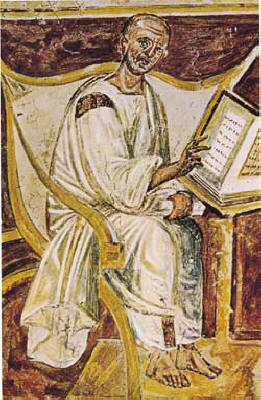 BEFORE thine eyes, O Lord, we bring our offences, and confess that the evil we have committed far outweighs what we suffer. We feel the punishment of sin, and yet we turn not from our wilfulness in sinning. If Thou waitest for our amendment, we are not corrected. If Thou chastiseth us, we are not patient. We confess our fault during our affliction, and forget our tears when the visitation is past. If Thou stretchest out thine arm, we proffer obedience; and if Thou suspendest the stroke, we forget our promise. If Thou punishest, we cry for mercy; and if Thou sparest, we provoke Thee again to strike. Behold, O Lord, we confess our guilt. Thy hand is not shortened that it cannot save. Neither is thine ear dull that it cannot hear. Thou hast shown us the manner we may come before Thee, requiring us to act justly, to love mercy, to walk humbly before Thee, and trust, finally, in the merits of our Lord Jesus Christ, who died for our sins and rose again for our justification.
Remember not, O Lord, our offences, nor those of our parents, and take not vengeance on our sins.
Saturday, August 19, 2017
Candace: A Christian Name from Nubia
Nubia was an extremely old civilization, with close cultural ties to Egypt that go all the way back to the dawn of Egyptian history. It even developed its own distinct adaptation of Egyptian hieroglyphics called Meroitic. The alphabetic hieroglyphs above are read from right to left. They are enclosed in an oval cartouche, indicating that they are part of a royal name; the three dots to the right are a word separator, and then the four symbols, reading towards the left, spell out k-t-k-e. The Greek transliteration is shown below.
One of Nubia’s most visible contributions to Western Christianity is the name Candace. We get it from the New Testament Greek form Κανδακη and the Candacis of the Latin Vulgate, as it appears in the story of St. Philip baptizing the Ethiopian eunuch in Acts of the Apostles:
"And behold, an Ethiopian, a eunuch, a minister of queen Candace of Ethiopia, who was in charge of all her treasures, had come to Jerusalem to worship" -Acts 8:27Candace ultimately comes from ktke, the word for "queen" or perhaps "queen mother" in the language of ancient Nubia. In the Meroitic script, it is rendered as follows:

This research will be featured in my forthcoming book "The Church for Our People: Studies in Afro-American Inculturation".
The Kisses that Killed Prejudice
On a cold January morning, in the year of Our Lord 1892, the Reverend Dr. Henry L. Phillips entered a Catholic Church and stayed to observe High Mass. He was not himself Catholic. In fact, he was rector of the Crucifixion Protestant Episcopal Church of Philadelphia. But he was a black minister serving a black congregation, and he was there for a special event: the Third Colored Catholic Congress, whose purpose was to gather black Catholic leaders across the United States. Its opening Mass was celebrated by the first recognized black priest in the nation: Father Augustus Tolton. And assisting Father Tolton that day were two white priests: Father John Burke as deacon, and Father John Griffin as subdeacon.
Two days later, Reverend Phillips had occasion to address the delegates to the congress. He said that during the Mass on Tuesday, he had been watching with the closest interest these two white priests at Father Tolton’s side. And what he saw there made a great impression on him. In no other denomination, he said, could such a thing be seen, or would it be permitted.
Because extensive changes to the Mass have taken place since that time, it is easy, perhaps, to miss the full significance of what Reverend Phillips saw that Tuesday morning in Philadelphia. We might simply assume that his remarks merely involve a black priest serving at the altar with white ones. Of course, this would indeed have been a remarkable image in an environment of widespread racial prejudice. But yet that alone doesn’t seem to entirely justify Phillips’ rather striking remarks. Would black and white ministers together really be unseen or unpermitted in any other denomination? Why would a few white priests sitting in on Father Tolton’s Mass be such cause for amazement?
Well, it’s not recorded what exactly Phillips saw that struck him at that Mass. But we can make an educated guess simply by placing the ceremony in its proper liturgical context.
Now if you have been to any traditional Latin High Mass, you’ve probably seen that it includes a number of kisses. These are known as the solita oscula. When the deacon and subdeacon hand an object to the priest or receive one from him, they kiss both the object and the hand of the celebrant. Also, the subdeacon kneels before the celebrant and kisses his hand after reading the Epistle. Then the deacon does the same thing before reading the Gospel. To anyone carefully watching the activity at the altar, these kisses are quite prominent, as are the many other places where the deacon and subdeacon act as humble servants to the celebrating priest.
But imagine these rubrics carried out at Tolton’s Mass on that winter morning in 1892. Two white priests publicly serving, kneeling before, and especially, and repeatedly, kissing the hands of a black priest.
That sight alone could well have been positively shocking in a country that was going through what some historians regard as the low point of American race relations. In that same year of 1892, the number of lynchings would reach a horrible peak of 230, never to be exceeded since. The supposedly “gay” nineties would see new state constitutions disenfranchising voters throughout the South, as well as the northern-dominated Supreme Court enshrining “separate but equal” in Plessy vs. Ferguson.
In his address to the Third Colored Catholic Congress, Dr. Phillips would go on to say that it was true, he knew, that at the altars of the Catholic Church there was no distinction as to color, and that Church has a lever possessed by none other to secure for the colored people the same rights in the workshops as it freely grants them in its sanctuaries. If it exerts its powerful influence to this end, he said, it will be scared by the rush of colored people to its fold and, as for himself, he would bid his three boys Godspeed if they desired to enter the ranks of that or any other Church which would secure for them their just rights.
As American Catholics we have not, sadly, always made use of that lever as well as we should, and our failings in that regard have undoubtedly been the reason that the rush of black Americans into the Catholic Church never quite materialized the way that Daniel Rudd and the other delegates had hoped. Liturgically, also, we seem to have lost all patience for these little gestures of service that undoubtedly so moved Reverend Phillips.
But it is worth remembering that in one of our country’s most shameful hours, an observant clergyman saw how justice and equality could flow out in torrents, if we could only learn to lower ourselves before the altar of God, to see Christ in every human being, and to kill every last prejudice with a kiss.
Subscribe to:
Posts (Atom)